
Get Your Free Cash Offer Now!
Fill out this form to get your no-obligation all cash offer started!
"*" indicates required fields
What Ohio Dower Rights Actually Are
Ohio dower rights are codified in Ohio Revised Code Chapter 2103. Under ORC § 2103.02, a spouse who is not on the deed of real property owned by the other spouse during the marriage has a present, contingent interest in the property that vests in the surviving spouse at the death of the property-owning spouse. The interest is a 1/3 life estate in all the real property of which the owning spouse was seized at any time during the marriage.
In modern Ohio real estate practice, dower has two practical consequences that matter to a divorcing homeowner:
- Title cannot transfer free and clear of dower without a release. Any Ohio house sale during the marriage requires either (a) the non-titled spouse to sign the deed or a separate dower release acknowledged before a notary, or (b) a certified divorce decree that extinguishes dower as of its effective date. Without one of these, the title is encumbered by the dower interest and most title insurance underwriters will not insure the transaction.
- Mortgage transactions during the marriage require dower release too. Even when only one spouse is borrowing on the mortgage, the lender typically requires the non-borrowing spouse to sign a release of dower so the lender's lien has clear priority over the dower interest. This is why the non-borrowing spouse is usually asked to sign mortgage documents at closing in Ohio.
Dower applies regardless of when the property was acquired. A house owned by one spouse before the marriage, gifted to one spouse during the marriage, inherited by one spouse from a parent — all are subject to dower if the owner is married at the time of any sale, regardless of how the property came into the owner's hands.
When Does Dower Get Extinguished?
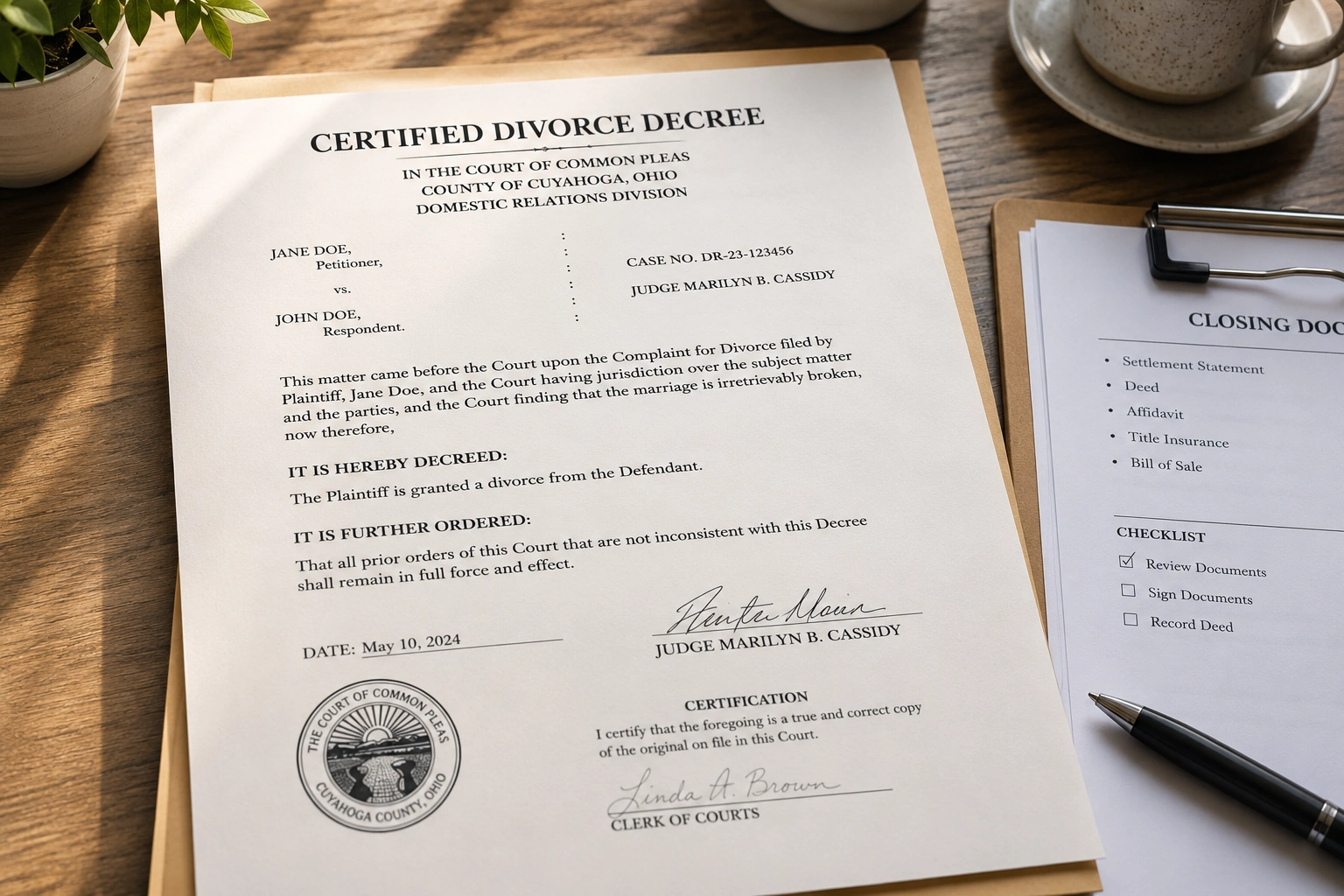
Ohio law provides three primary mechanisms for ending the dower interest in a specific property:
- Voluntary written release. The non-titled spouse signs the deed at closing, or signs a separate dower release acknowledged before a notary, relinquishing dower in the specific property being conveyed. This is how the overwhelming majority of Ohio closings during marriage handle dower — including in cooperative divorce situations where both spouses agree to the sale.
- Divorce, dissolution, or annulment under ORC § 3105.10. A certified divorce decree, dissolution decree, or annulment decree that recites the termination of property and dower rights ends dower as of the effective date of the decree. Title companies routinely require a certified copy of the decree in the closing file. Most well-drafted Ohio divorce decrees include specific language terminating dower rights — talk to your divorce attorney about confirming this language is in the final decree.
- Judicial sale under ORC § 2103.041. In a creditor proceeding such as foreclosure, the dower interest can be subjected to sale without spousal consent. The non-titled spouse is awarded a sum of money equal to the present value of the dower interest from the sale proceeds. This mechanism is used in foreclosure cases involving married property owners but is not generally available in a voluntary sale.
There are also some less-common dower-termination scenarios — death of the property owner, abandonment combined with adultery under ORC § 2103.05, and certain pre- or post-nuptial agreement waivers — but the three mechanisms above cover the practical situations a divorcing Ohio homeowner is likely to encounter.
Three Common Scenarios and How Dower Plays Out
Scenario 1: Cooperative Sale Before Divorce Decree
Both spouses agree to sell the house while the divorce is pending. Both spouses sign the purchase agreement. Both spouses sign the deed at closing — the titled spouse conveys ownership, and the non-titled spouse signs a release of dower on the same instrument. The title company accepts the signatures, issues clean title insurance, and the transaction closes normally. Proceeds are typically wired to an attorney trust account designated in a partial settlement agreement, or held in escrow pending the final divorce decree's property division order.
This scenario is the cleanest path for a cooperative divorcing couple in Ohio. It eliminates the question of whether the sale price might change based on equitable distribution proceedings, locks in the current market value, and removes the carrying cost burden of joint ownership during a multi-month MLS listing.
Scenario 2: Sale by One Spouse After Divorce Decree
The divorce decree has been entered. The decree awarded the marital home to one spouse as part of the property division. The receiving spouse now wants to sell. Under ORC § 3105.10 and the dower release language in the decree, dower has been extinguished as of the decree's effective date — but the title company will require a certified copy of the decree in the closing file to confirm this.
This scenario works smoothly if the divorce attorney included clear dower-termination language in the final decree. It works less smoothly if the decree is ambiguous or silent on dower. Talk to your attorney before the final decree is entered to confirm the dower language is included — fixing it after the fact requires either re-engaging the former spouse to sign a separate release or going back to the domestic relations court for a clarifying order, both of which add time and cost.
Scenario 3: Sale by One Spouse Without the Other's Cooperation
One spouse wants to sell. The other spouse refuses to sign anything related to the sale. This is the most complex dower scenario in Ohio. Several possible paths:
- Domestic relations court order. The court can order the non-cooperating spouse to sign dower release documents as part of the equitable distribution proceeding. Contempt remedies are available if the spouse refuses to comply with the order.
- Judicial sale by special master or commissioner. The court can order the sale of the marital home and appoint a special master or commissioner to execute the deed on behalf of the non-cooperating spouse. This is slower than a voluntary sale and tends to produce lower gross sale prices because of the forced nature of the transaction.
- Wait for the divorce decree. If the divorce is close to final, sometimes the most efficient path is to wait until the decree is entered and dower is extinguished by operation of law, then sell as the sole owner.
Honest Offer Homes has closed Ohio house sales in all three of these scenarios. The transaction structure adapts to the legal posture; the closing mechanics work the same once the dower question is resolved.
What Sellers in Cleveland Say About Honest Offer Homes

"I needed to sell fast, and they made it simple."
I relocated for work and didn't want to list it. Honest Offer Homes closed quickly and handled everything.

Sarah R., Cleveland

Mike L., Cleveland
"They gave me a fair offer for my rental."
Tenants left the place in bad shape. I didn't have time or money to fix it. They still bought it fast.

Denise T., Cleveland
I inherited a house I didn't want. They were professional and easy to work with.
I inherited a house I didn't want. They were professional and easy to work with.
Practical Steps for a Divorcing Ohio Homeowner Considering a Sale
- Step 1: Confirm marital status with the title company up front. A title commitment in Ohio will identify whether the seller is married and will spell out the dower release requirements. Get this in writing before you sign a purchase agreement.
- Step 2: Coordinate with your divorce attorney. If you are pre-decree, the cash sale process needs to integrate with the divorce proceedings. Your attorney can confirm the proceeds distribution mechanics, the escrow structure, and any court approval requirements for selling marital property during the divorce.
- Step 3: If you are post-decree, gather the certified copy of the divorce decree before listing or entering a purchase agreement. The title company will want it in the file. If the dower language in the decree is unclear or missing, address it with your attorney before the closing date — not the day of.
- Step 4: Communicate with the non-cooperative spouse through counsel. If the situation is contentious, all communication about the sale should run through attorneys. Direct conversation between spouses about a contested house sale tends to escalate the dispute and rarely produces a better outcome.
- Step 5: Choose a buyer experienced in Ohio dower situations. A national cash-buyer franchise operating out of Texas or Florida may not know what dower is and may bring closing-day surprises. A local Cleveland or Ohio-statewide buyer handles dower as a standard transaction component.
Frequently Asked Questions
1. Can I sell an inherited house in Ohio before probate is closed?
Yes. Under Ohio Revised Code Chapter 2113, an executor with the power of sale (granted by the will, or by court order under ORC § 2127 if the will is silent) can sell estate real property during probate. Proceeds go into the estate account and are distributed at the end of probate per the will and the final court order.
2. Do I owe Ohio estate tax on an inherited house?
No. Ohio repealed its estate tax effective January 1, 2013 under ORC § 5731. Federal estate tax only applies to estates above approximately $13 million, which is well above any single Ohio home. The overwhelming majority of Ohio heirs owe no estate tax of any kind on an inherited home.
3. How fast can a cash buyer close on an inherited Cleveland house?
Honest Offer Homes can issue a written cash offer within 24 to 48 hours and close in as few as 14 days from accepted offer, once the executor has authority to convey. If the probate timeline requires waiting for Letters or court approval, we schedule closing to match the estate's readiness.
4. Do I need to clean out or repair the inherited house before selling to Honest Offer Homes?
No. We buy inherited homes in any condition, including hoarder situations, vacant properties, water damage, structural issues, or properties with code violations. You leave whatever is in the house — we handle the cleanout after closing. No repairs, no staging, no inspection contingencies.
5. What if multiple siblings inherited the house and we do not all agree on selling?
If the will names a single executor with power of sale under ORC § 2113, the executor can typically sell without requiring every beneficiary's signature on the closing documents. If the executor lacks that authority, the probate court can authorize the sale under ORC § 2127. A written cash offer in front of every sibling at the same time often resolves disagreements before court intervention becomes necessary.
Get Your Free Cash Offer Now!
Fill out this form to get your no-obligation all cash offer started!
"*" indicates required fields
Honest Offer Homes and Ohio Dower
We close Ohio divorce house sales regularly. Dower release is handled as a standard part of our closing process. We accept either form of dower termination — voluntary release at closing or certified divorce decree — and we work with the divorce attorneys representing each spouse to ensure the closing mechanics align with the settlement agreement and court orders. We do not close transactions where the dower question has not been resolved, because doing so would create title problems for our own ownership going forward.
If you are an Ohio divorcing homeowner and want a real number against the house with the dower considerations addressed up front, send us the property address and a brief note on the situation. We will come back within 48 hours with an offer and a clear plan for handling dower as part of the closing.