
Get Your Free Cash Offer Now!
Fill out this form to get your no-obligation all cash offer started!
"*" indicates required fields
How Cuyahoga County's Foreclosure Process Differs From the Rest of Ohio
The Ohio Revised Code provides a uniform framework — ORC § 2323.07 for judicial sale, ORC Chapter 2329 for sheriff's sales — but the practical execution varies meaningfully by county. Cuyahoga County's distinguishing features:
- High case volume in the Cuyahoga County Court of Common Pleas. The civil docket processes thousands of foreclosure cases annually, which produces longer typical timelines than smaller counties. A Cuyahoga foreclosure can run 9 to 14 months from complaint to sheriff's sale, where a Stark or Lorain County case might run 6 to 9 months.
- Mandatory mediation. The Cuyahoga County foreclosure mediation program — operated by the court of common pleas in cooperation with United Way's Housing Resource Center — requires lender participation in mediation before summary judgment in residential cases. Mediation can resolve cases through loan modification, deed-in-lieu, short sale, or other alternatives. The program adds 60 to 120 days to the timeline and produces a meaningful number of non-foreclosure outcomes annually.
- Active tax foreclosure pipeline. The Cuyahoga County Prosecutor's office runs an aggressive Delinquent Tax Assessment Collection (DTAC) program. The Treasurer's office maintains an active foreclosure prevention resource at cuyahogacounty.gov. The Land Bank — one of the largest in the United States — absorbs many distressed properties that come through the tax foreclosure pipeline. This combination means tax foreclosure in Cuyahoga moves more methodically than in many other Ohio counties but with more institutional capacity behind it.
- Online sheriff sales. Cuyahoga County conducts all sheriff's sales through the statewide RealAuction platform mandated by ORC § 2329.153. The auctions are open to bidders nationwide, which broadens the buyer pool — but also means properties at second sale are routinely acquired by institutional buyers from outside the region.
- Active community legal aid presence. The Legal Aid Society of Cleveland is one of the largest legal aid organizations in Ohio and a primary resource for homeowners facing foreclosure. Through Ohio Legal Help (ohiolegalhelp.org), Cuyahoga homeowners can access counseling and representation at no cost when they qualify.
Cuyahoga County's Tax Foreclosure Problem
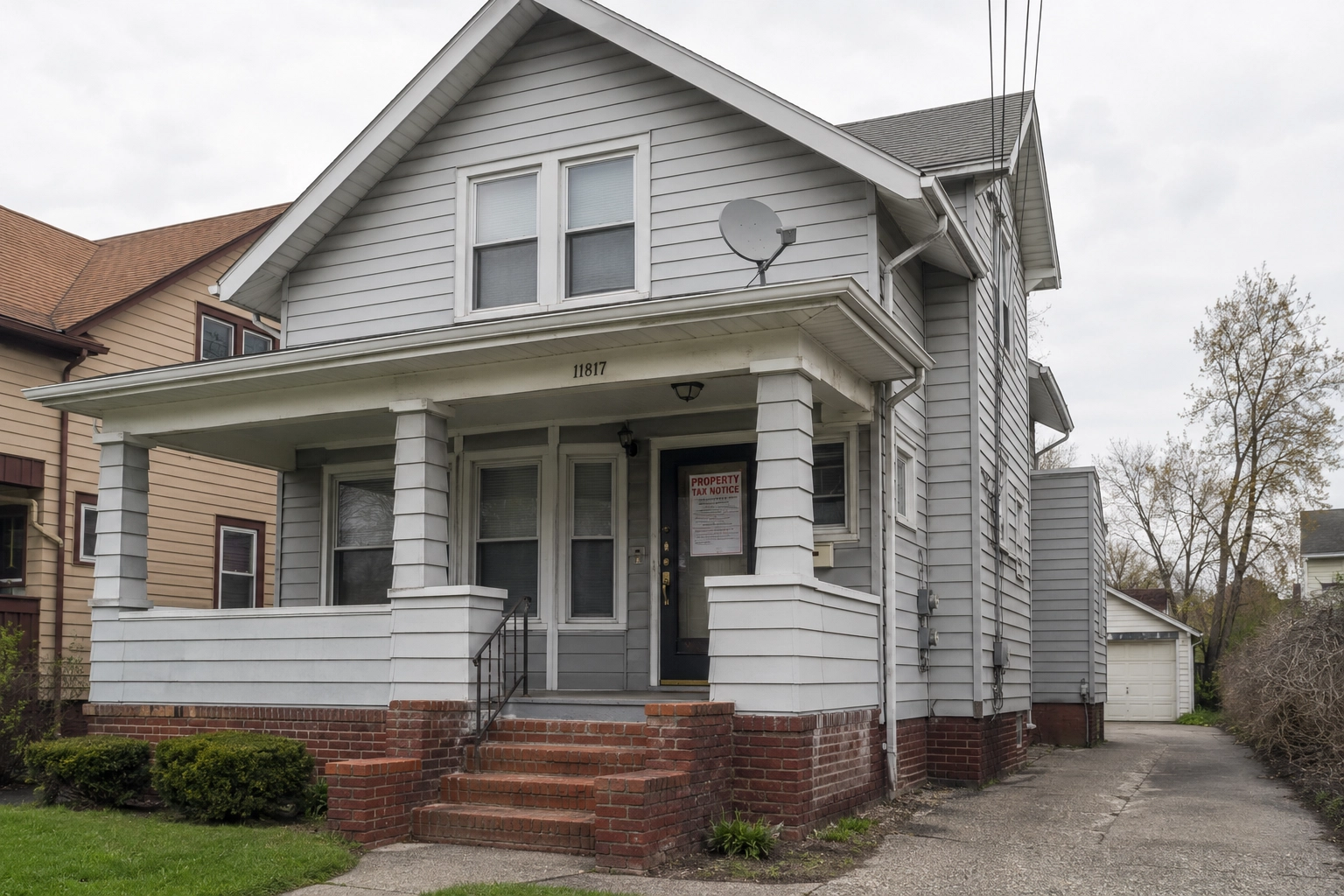
The county has a structural tax foreclosure problem that does not exist at the same scale in many other Ohio markets. The underlying drivers:
- Aging housing stock. Cuyahoga County has tens of thousands of homes built between 1920 and 1970, many owned by retirees on fixed incomes. As property tax rates and assessed values have climbed, fixed-income owners have fallen behind.
- 2024 reappraisal cycle. Cuyahoga County's most recent reappraisal raised assessed values significantly across many neighborhoods. The tax bills reflecting those new values began arriving in 2025 and 2026, and the resulting delinquencies are now feeding the 2026 tax foreclosure pipeline.
- Land Bank as a structural buyer. The Cuyahoga Land Bank acquires distressed tax-foreclosed properties from the county for stabilization, demolition, or transfer to new owners. This absorbs many properties that would otherwise sit vacant after foreclosure — but it also means the county has institutional capacity to keep the tax foreclosure pipeline moving.
What Sellers in Cleveland Say About Honest Offer Homes

"I needed to sell fast, and they made it simple."
I relocated for work and didn't want to list it. Honest Offer Homes closed quickly and handled everything.

Sarah R., Cleveland

Mike L., Cleveland
"They gave me a fair offer for my rental."
Tenants left the place in bad shape. I didn't have time or money to fix it. They still bought it fast.

Denise T., Cleveland
I inherited a house I didn't want. They were professional and easy to work with.
I inherited a house I didn't want. They were professional and easy to work with.
Where Cleveland-Area Homeowners Can Get Help
If you are a Cuyahoga County homeowner facing mortgage foreclosure, tax foreclosure, or both, these are the county-specific resources to know:
- Cuyahoga County Treasurer — Foreclosure Prevention. The Treasurer's office at cuyahogacounty.gov maintains the canonical Cuyahoga foreclosure prevention resource page, with information on the EasyPay payment plan program, the 67-plus tax assistance program, and the DTAC process.
- Cuyahoga County Foreclosure Mediation Program. Through the Cuyahoga County Court of Common Pleas. If you have been served with a foreclosure complaint, you may be eligible for mediation — request a referral through the court.
- Legal Aid Society of Cleveland. The largest legal aid organization in Ohio. Free legal services for qualifying Cuyahoga homeowners, including foreclosure defense and surplus funds claims. Accessible through Ohio Legal Help at ohiolegalhelp.org.
- Save the Dream Ohio (OHFA). The Ohio Housing Finance Agency's mortgage assistance program at savethedream.ohiohome.org. Program availability and eligibility have shifted as federal funding has changed, but the agency continues to maintain housing counseling resources for Ohio homeowners.
- HUD-approved housing counseling agencies in Cuyahoga County. Free counseling for homeowners in distress. The Cleveland Housing Network, ESOP (Empowering and Strengthening Ohio's People), and Neighborhood Housing Services of Greater Cleveland are among the local agencies. Search by ZIP at hud.gov/counseling.
Cleveland Neighborhoods With Concentrated Foreclosure Activity
Foreclosure activity in Cuyahoga County is not evenly distributed. Concentrations in 2026 include:
- Mid-Cleveland east-side neighborhoods — Glenville, Hough, Mount Pleasant, and parts of Buckeye-Shaker — continue to carry the legacy of pre-2008 lending practices and the slower price recovery on the east side.
- Inner-ring suburbs with aging housing stock — Maple Heights, Garfield Heights, Bedford, Euclid, parts of Cleveland Heights — face the tax foreclosure pipeline as senior owners age out of fixed-income capacity.
- Parma and the western inner-ring suburbs are seeing more mortgage foreclosure activity tied to layoff stress from First Brands Group's Cuyahoga County facilities and other automotive parts manufacturers.
- Lakewood and the western edge of Cleveland have seen relatively less foreclosure activity due to stronger home values and a younger ownership demographic, but tax foreclosure cases still appear quarterly on the docket.
If You Have Equity in a Cuyahoga County Home Facing Foreclosure
Cleveland-area home prices have appreciated steadily since 2015. The median list price in Cleveland reached $149,900 in March 2026, up 7.1 percent year over year. Active listings in the city rose 14.6 percent year over year — a more balanced market than the recent past but still favorable to sellers who can present clean transactions. For a long-term Cleveland homeowner facing foreclosure, equity is often the unrealized asset most at risk in the sheriff's sale process.
A cash sale before sheriff's sale lets a Cuyahoga County homeowner convert that equity into liquid funds — preserving the resource that a sheriff's sale at two-thirds appraised value (or worse, at second-sale no-minimum) would often eliminate entirely. The math we walked through in the pillar applies here: at typical Cleveland-area home values and judgment amounts, a pre-sale cash transaction routinely preserves $20,000 to $80,000 of equity that would otherwise be lost.
Frequently Asked Questions
1. How long does a Cuyahoga County foreclosure take?
A Cuyahoga County foreclosure typically runs 9 to 14 months from complaint filing to sheriff's sale — longer than the Ohio state average of 6 to 12 months due to high case volume in the Court of Common Pleas and the county's mandatory foreclosure mediation program.
2. What is the Cuyahoga County foreclosure mediation program?
The Cuyahoga County Court of Common Pleas operates a foreclosure mediation program in cooperation with United Way's Housing Resource Center. Lender participation is required before summary judgment in residential cases. Mediation can resolve cases through loan modification, deed-in-lieu, short sale, or other alternatives, and adds 60 to 120 days to the timeline.
3. How does Cuyahoga County tax foreclosure work?
Cuyahoga County's tax foreclosure pipeline runs through the Treasurer's office (initial delinquency and tax lien sales) and the Prosecutor's Delinquent Tax Assessment Collection (DTAC) program. After roughly 2 years of delinquency, the prosecutor files a tax foreclosure complaint in the Court of Common Pleas. Tax foreclosures in Cuyahoga County have totaled 16,410 from 2019 through early 2026 — exceeding the 14,659 mortgage foreclosures over the same period.
4. What help is available for Cuyahoga County homeowners facing foreclosure?
The Cuyahoga County Treasurer maintains a foreclosure prevention page at cuyahogacounty.gov, the EasyPay payment plan program for delinquent taxes, and the expanded property tax assistance program for homeowners 67-plus providing up to $10,000 in delinquency relief. The Legal Aid Society of Cleveland, Cleveland Housing Network, ESOP, and Neighborhood Housing Services of Greater Cleveland provide free counseling and legal services. Ohio Legal Help (ohiolegalhelp.org) connects qualifying homeowners with attorneys at no cost.
Get Your Free Cash Offer Now!
Fill out this form to get your no-obligation all cash offer started!
"*" indicates required fields
Honest Offer Homes in Cuyahoga County
Honest Offer Homes is headquartered in Cleveland and purchases homes across Cuyahoga County in any condition and at any stage of the foreclosure process. We work with the Cuyahoga County Court of Common Pleas docket, the foreclosure mediation program, the Treasurer's office, and local title companies routinely. We do not chase homeowners through the advertising window before sheriff's sales. We do not send predatory mailers. We send a written offer within 48 hours of contact, and the number we send is the number that closes.
If you are a Cleveland-area homeowner facing foreclosure and want a real number against your specific situation, send us the property address and a brief note on where the case stands. No obligation. No follow-up if the path is not right for you.