
Get Your Free Cash Offer Now!
Fill out this form to get your no-obligation all cash offer started!
"*" indicates required fields
Cleveland Ordinance 3106 — The Specifics
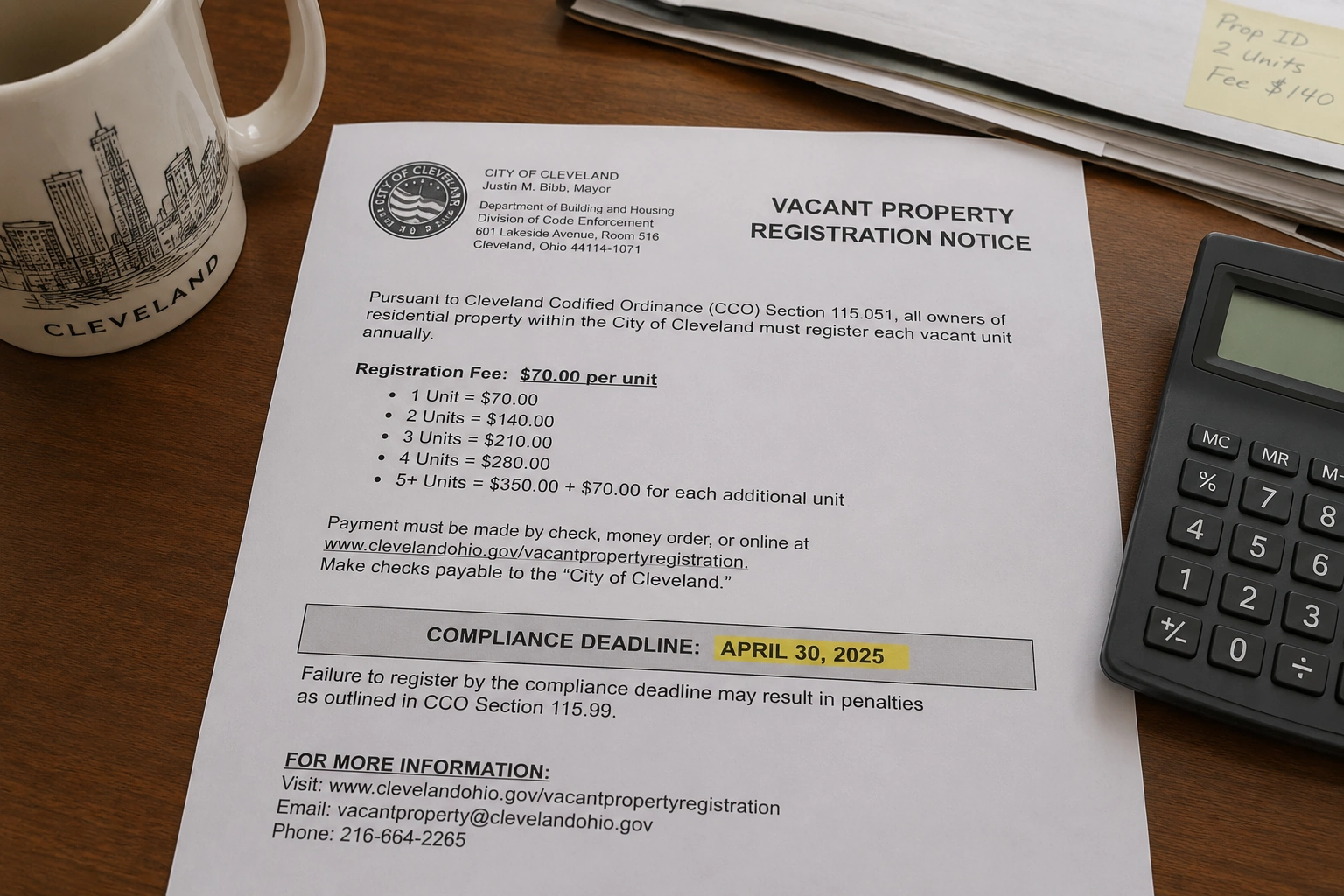
Chapter 3106 of the Cleveland Municipal Code governs the registration of vacant buildings. The 2026 framework:
- Annual registration required for all vacant structures in Cleveland. Registration is filed online through the Accela permit portal (aca-prod.accela.com/COC). The registration must be renewed annually until the building is no longer vacant.
- Annual registration fee: $70 per dwelling unit for 1-3 family vacant residential properties. $1,000 annual fee for commercial vacant property and for residential buildings with 4 or more units.
- Cash bond requirements (commercial only): $5,000 for buildings 10,000 square feet or smaller; $15,000 for buildings 10,000 square feet or larger. The bond must be maintained throughout vacancy and can be used by the city to abate nuisance conditions at the property.
- Local Agent in Charge (LAIC) requirement: Owners who do not reside in Cuyahoga County or a contiguous county must designate an individual who resides in Cuyahoga County as the LAIC. The LAIC is legally responsible for the property along with the owner.
- Effective February 6, 2026: The City of Cleveland no longer requires a mandatory exterior inspection before the sale or transfer of 1-3 unit vacant residential properties. This change materially reduced closing-time friction for sellers of small vacant residential property in Cleveland. Vacant building registration is still required and routine inspections continue.
- Code enforcement penalties: Violations of Ordinance 3106 can result in fines, increased registration fees, and code-enforcement actions through the Cleveland Housing Court. Continued non-compliance can result in receivership actions and demolition orders for severely deteriorated properties.
For an owner with a single Cleveland 1-3 family vacant property, the direct ordinance cost is modest — $70 per unit annually plus the cost of designating an LAIC if applicable. The indirect cost is larger: the regulatory presence, the paperwork burden, the compliance risk, and the operational attention the ordinance requires every year the property remains vacant.
Vacant Property Ordinances in Other Major Ohio Cities
Cleveland's Ordinance 3106 is the most prominent, but similar regulatory frameworks exist statewide:
- Columbus — operates a Vacant Building Registry under Columbus City Code Chapter 4555. Annual registration fees and inspection requirements vary by property type.
- Cincinnati — maintains a Vacant Building Maintenance License (VBML) program under Cincinnati Municipal Code Chapter 1101. Annual fees and compliance inspections required.
- Akron — operates a vacant and abandoned property registration program through the Department of Neighborhood Assistance. Annual fees and maintenance standards apply.
- Toledo — Vacant Property Registration Program under Toledo Municipal Code with annual fees.
- Dayton — Vacant Property Registration Program operated by the Department of Planning and Community Development.
Specifics vary city by city. If you own a vacant property in any major Ohio metro and have not researched the local registration requirements, this is worth a 30-minute investigation — the compliance costs add up quickly and the penalties for non-registration are usually meaningfully larger than the registration fees themselves.
How a Cash Sale Eliminates the Ongoing Ordinance Burden
The Cleveland vacant property registration obligation transfers to the new owner at closing. As of the closing date, the seller is released from all future registration obligations, fees, LAIC requirements, and code enforcement exposure related to the property. The new owner — typically a cash buyer who has factored the ordinance compliance into their underwriting — handles the registration going forward and either repositions the property for occupancy or sells it after rehab to an owner-occupant who will use the home and exit the vacant property registry.
For an out-of-state Ohio property owner, this is the most underrated benefit of the cash sale. The Cleveland Ordinance 3106 obligations — the annual fee, the LAIC requirement, the inspection exposure, the code enforcement risk, the operational attention — disappear from the owner's life entirely as of closing. The owner stops being a Cleveland vacant property compliance subject and starts being a former Ohio property owner.
Sight-Unseen-by-Owner Vacant Property Sales
Vacant property sales differ from owner-occupied sales in one practical respect: the owner often has not been inside the property in months or years and does not know exactly what the interior condition is. Cash buyers — Honest Offer Homes and our peers in the Cleveland market — close these transactions sight-unseen-by-owner regularly. The mechanics:
- The buyer hires their own inspector and conducts their own interior assessment with whatever access can be arranged (often a locksmith and a property management visit for a property where the owner does not have current keys).
- The buyer's offer reflects the property's actual condition, including any deferred maintenance, code citation history, or condition issues discovered during diligence.
- Closing happens remotely. The owner signs the deed and closing documents via mobile notary or by power-of-attorney through a local Cleveland title attorney. The owner does not need to travel to Cleveland for the closing.
- Net proceeds wire to the owner's designated account on the closing date. Property registration transfers to the buyer. The owner's relationship with the property is over.
For a Pittsburgh-based owner of an East 65th Street Cleveland vacant property, this is a 14 to 30 day project from initial contact to wired proceeds — without ever flying back to Cleveland to deal with the property in person.
What Sellers in Cleveland Say About Honest Offer Homes

"I needed to sell fast, and they made it simple."
I relocated for work and didn't want to list it. Honest Offer Homes closed quickly and handled everything.

Sarah R., Cleveland

Mike L., Cleveland
"They gave me a fair offer for my rental."
Tenants left the place in bad shape. I didn't have time or money to fix it. They still bought it fast.

Denise T., Cleveland
I inherited a house I didn't want. They were professional and easy to work with.
I inherited a house I didn't want. They were professional and easy to work with.
What If the Vacant Property Has Code Citations or Worse?
Cleveland's Housing Court actively pursues code enforcement against neglected vacant properties. By the time some owners reach the point of selling, the property has accumulated $2,000 to $25,000 of code citations, exterior maintenance demands, board-up orders, or other municipal enforcement costs. Cash buyers who specialize in distressed Cleveland property routinely absorb these citations as part of the closing — the seller does not need to clear the citations before selling. The buyer takes the property subject to the existing citations and resolves them as part of their own rehab process.
Similar logic applies to vacant properties with squatter situations. Under Ohio's adverse possession standard, a squatter must occupy a property continuously, openly, hostilely, and adversely for 21 years before any legal claim to ownership matures — meaning a 6-month or 12-month squatter situation does not create a serious title risk. But the squatter still has to be removed through the formal eviction process under ORC Chapter 1923. Cash buyers experienced with Cleveland vacant property typically take the property subject to the squatter situation and pursue the eviction themselves after closing.
Frequently Asked Questions
1. Can I sell an inherited house in Ohio before probate is closed?
Yes. Under Ohio Revised Code Chapter 2113, an executor with the power of sale (granted by the will, or by court order under ORC § 2127 if the will is silent) can sell estate real property during probate. Proceeds go into the estate account and are distributed at the end of probate per the will and the final court order.
2. Do I owe Ohio estate tax on an inherited house?
No. Ohio repealed its estate tax effective January 1, 2013 under ORC § 5731. Federal estate tax only applies to estates above approximately $13 million, which is well above any single Ohio home. The overwhelming majority of Ohio heirs owe no estate tax of any kind on an inherited home.
3. How fast can a cash buyer close on an inherited Cleveland house?
Honest Offer Homes can issue a written cash offer within 24 to 48 hours and close in as few as 14 days from accepted offer, once the executor has authority to convey. If the probate timeline requires waiting for Letters or court approval, we schedule closing to match the estate's readiness.
4. Do I need to clean out or repair the inherited house before selling to Honest Offer Homes?
No. We buy inherited homes in any condition, including hoarder situations, vacant properties, water damage, structural issues, or properties with code violations. You leave whatever is in the house — we handle the cleanout after closing. No repairs, no staging, no inspection contingencies.
5. What if multiple siblings inherited the house and we do not all agree on selling?
If the will names a single executor with power of sale under ORC § 2113, the executor can typically sell without requiring every beneficiary's signature on the closing documents. If the executor lacks that authority, the probate court can authorize the sale under ORC § 2127. A written cash offer in front of every sibling at the same time often resolves disagreements before court intervention becomes necessary.
Get Your Free Cash Offer Now!
Fill out this form to get your no-obligation all cash offer started!
"*" indicates required fields
Honest Offer Homes and Vacant Cleveland Property
We close vacant Cleveland sales weekly. We handle Ordinance 3106 transfer at closing. We work with owners who have not been inside the property in two years. We work with owners who are in Pittsburgh, Atlanta, Denver, Florida, anywhere — closings can happen entirely remotely. We accept properties with active code citations. We accept properties with squatter situations. We accept properties in any interior condition, regardless of what the photos look like.
If you have a vacant Cleveland (or Akron, Toledo, Cincinnati, Dayton, Columbus) property and want a real number against it without traveling back to Ohio, send us the address and a brief note on your current location. We will come back within 48 hours with an offer and a path to a remote closing.